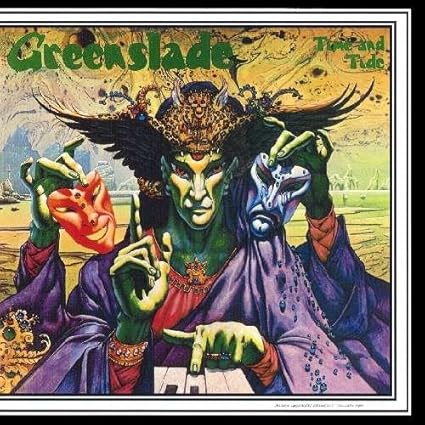
There's no doubt that Thomas was the less talented of the Dinger brothers, but Fur Mich – the title "For Me" being a reference to how his brother Klaus dominated their band La Düsseldorf – has some beautiful moments.
His drumming on the almost-title track Fur Dich (For You) is a clear reminder of La Düsseldorf, with a vaguely Christmassy melody, but the groove is infectious in the best Krautrock style and there's something quite lovely about the overlay of swirling synthesisers. Nothing else on the album quite matches it, but this is still a delightful listen. It's also the last time that Neu! motorik beat got an outing till the likes of Stereolab rediscovered it in the 1990s.
As rock'n'roll tragedies go, Wolfgang Riechmann is right up there. He
was the singer in Spirits Of Sound with Michael Rother (Kraftwerk, Neu!,
Harmonia) and Wolfgang Flür (Kraftwerk) in the 60s and had some success
with Streetmark in the 70s. He was well enough known that, when he made
a solo album, they only needed to put his surname on the album cover.
Yet
Wunderbar was unlike everything Riechman had done before: a gorgeous
electronic symphony that took the work of Tangerine Dream and Cluster
one step forward. Then, two weeks before the album was due to be
released, he was murdered by a lone, knife-wielding nutter in a bar. It
was as pointless a death as can be imagined. Would Wunderbar be a
diversion from his rock career, or the first step on a new electronic
career? We'll never know.
Even so, taken on its own merits,
Wunderbar is a delicious swarm of symphonic synth-pop: delicate yet
optimistic, without the portentousness of Tangerine Dream and looking
forward to the British synth-pop of a few years later when the Human
League and others synthesised electronic music into a music for the
masses. This is some of the warmest electronic music out there.
There are no bonus tracks. This album was perfect the way it was made.
Whenever I want to defend prog rock against the silly consensus that punk was the true revelation of the 70s, this album gives me pause. Amid the sub-Genesis pomposity, including the faux-Edwardian nostalgia, any good musical sections are quickly interrupted by Dave Lawson's horrible yelping vocals, in which every word of his terrible lyrics is cringingly audible. Even at the age of 10, when my brother brought this newly released album home, I thought the lyrics to Animal Farm and Newsworth especially were a bit naff, even though everything my cool elder brother brought home was itself ipso facto cool.
Of course Lawson's
vocals are the worst thing about this album, but the whole thing has an
air of out-takes and half-baked concepts. Disparate musical ideas are
shuffled about with no coherence at all, creating an impression of a
band recycling discarded tunes while waiting in vain for some real
inspiration to come along. For sure the tracks are shorter and less
self-indulgent than on earlier work, but there's nothing to suggest any
vision of where the band was to go. And the short answer to that implied
question is 'nowhere', since they broke up a few months after the
album's release.
I bought the first Stranglers album in 1977 and
didn't listen to this again for over 30 years. Revisiting it in 2014,
every note is familiar and the tweeness is just as bad as it was then.
The jazz-rock fusion of Colosseum is gone and we are left with a band -
and indeed a whole musical genre - that had no idea where it was going.
Maybe that most over-rated of all bands, The Ramones, were on to
something after all.
Call me cynical, but I'm almost embarrassed to admit to enjoying
Black Sabbath at Birmingham's National Indoor Arena. But I did, and big thanks
to George for inviting me and Tim, Guy, Rachel and Naomi for being fabulous
company, as always.
Being there matters less than telling people you were there
Sabbath were good, as were the support, but being a miserable old sod I
like moaning. It makes me happy. Besides, you can still enjoy a show without losing sight of the hopeless sterility of it all.
It's collusion. It's a conspiracy to ruin the gig-going experience. It's
not just the promoters. The venue, the band and dammit the audience are all in
on this.
First up, the band. The NIA is a huge stage. Geezer Butler stood on his own,
stage right, and looked like the loneliest man in Birmingham except when Ozzy shuffled
over a couple of times to check his pulse. When you've got a
right-handed bassist and a southpaw guitarist, they should be the other way
round. Having the necks of the guitars pointing inwards puts enough distance
between the players that they're not a band any more; just a collection of
individuals. Audience and band keep their distance, just in case any un-approved human interaction disrupts the carefully planned event.
And that's where the collusion with the venue comes in. They want
everything to be well-managed and ordered. The approved brand of beer comes in
approved plastic bottles, which have to be swapped for approved plastic glasses
before you go into the hall itself, where your wristband gets checked for the umpteenth time. There's no smoking, of course, but you
can't just go outside any old door for a puff - there's a designated outdoor
area squeezed between a building site and the car park, chosen specially for
being the most grim and miserable place to stand on a wet evening in December. It's unapproved fun, and if we can't stop it we'll make it as unpleasant as we can. Apart from every single played on Top Of The Pops in 1975-6, the worst thing about 70s music was the drum solo, but here at least it served a function. I managed to barge my way out of the hall, buy a beer, traipse about three miles to the smoking area, buy some merchandise and still get back in time for the crunching opening chords of Iron Man.
Sabbath make a great noise live, and the acoustics at the NIA are the best
I've ever heard in a sports hall, but Ozzy Osbourne has to be one of the worst
frontmen in the history of rock. He was in very good voice, but there's more to
fronting a rock band than just singing. Ozzy knows this, but someone should
have told him years ago that shuffling across the stage in a semi-crouch like
an old man queuing for a soup kitchen, clapping his hands and shouting
"Yeah!" at every opportunity doesn't make you Dave Lee Roth. A couple of times in every
song he approaches the mic and bellows, "Lemme see yer hands!" before
sobbing "We love you," at the end of almost every song.
Then there's the bossing of the audience. When Ozzy says, "This is
Tony Iommi; shout his name!" you either shout his name, and a few of the
audience did, or you shout, "We know it's Tony fucking Iommi," as we
did. And when Ozzy shouts "Jump!", you jump. Most of the crowd did.
They were distressingly obedient.
Rock now has rules, and the audience obeyed them. Old farts from the first time round (us), some
of them with their teenage kids, turned it from a gig into a day trip to a heavy rock
theme park. Ozzy bellowed “Lemme see your hands” again, but
most people already had their hands up, brandishing smartphones
and even the occasional iPad set to record video. They didn’t come to a live event; they’d come to
a life event and were determined to record the fact so they could tick it off
their list of 1,000 Things To Do Before Finally Admitting You Really Are A Sad
Old Git And Probably Always Were.
And What did they record? A sea of tiny
screens in front of them recording the sea of tiny screens in front of them, and way off in the distance, an enormous
screen that dominated the stage, relaying live film of the concert for those too far
back to see. Just possibly they might have caught the odd band member, but that
was incidental. They didn't come to a gig; they came to to collect social-media-friendly evidence that they'd attended An Event. All this so that when they got home they could upload it onto Facebook and
YouTube, so all their friends, acquaintances, work colleagues, former schoolfriends
and random people they met at a party four years ago could see their amateur
film of a professional film of an event they could actually have seen live if
they weren’t so obsessed with their iWanks.
Finally there’s charade of the encore: “We’ll do one more song if you make
enough noise.” Or, “You’ve paid for it, but you’ve still got to beg.” I said to
Guy, “I wonder what they’ll do if we all keep really quiet.” The audience did their best, but it’s difficult to
summon up the passion. Rock’n’roll ceased to be a life-changing experience long
ago, and it was all a bit forced. Still, Sabbath played their role in the
farce: they went off stage long enough to put the kettle on and put four
teaspoons of Ovaltine in four mugs before returning to the stage, noodling
around with the riff of ‘Sabbath Bloody Sabbath’ and finally asking what we
wanted to hear. “Neon Knights!” we bellowed, but they didn’t seem to hear.
Eventually they lurched into ‘Paranoid’, which was a bit of a shock. I assumed
they’d left it out because they were sick of playing it. “I preferred the
Dickies’ version,” said Guy, but we all bounced along just the same.
Then the balloons came down. They were meant to be black, but most of them were a shade that can only be described as deep purple. Maybe Ian and the boys had been in town and had a few left over. The lights came up and everyone queued for the car park while the band went back to the hotel for muffins and bed.
The rituals of rock are getting as rigid as those of the Catholic Church, and the inclusion of ‘Dirty Women’ – complete with ‘retro’ (thus ironic and
not sexist at all) topless photos on the huge screens – shows that rock's attitude
to women is no more advanced. In both cases the rituals are slick, well-rehearsed and professional, but the original message was lost long ago. Track listing
It's said that Leonardo da Vinci invented the helicopter, the parachute
and the robot, all in the 15th Century. If he'd invented the elevator,
this album would be playing in it.
Despite being released in 2010, Blackmore's renaissance lift music has the added annoyance of vocals and lumpen production in a 1980s style, with opening track Highland evoking unpleasant memories of Big Country. It all adds to the misery of hearing one of rock's great guitarists wallowing in stickily sentimental ballads or hey-nonny-nonny folk dances to be played in a Tudor theme park that nobody has built. Only 'Song & Dance pt.II'
pulls it off with any panache.
The music evokes an era of poverty, plague and the pox, any of which would be preferable to hearing this again.
Krautrock is one of the most neglected yet important genres in popular music. Without it, 70s rock would have been doomed to keep aping the blues with ever-diminishing marginal returns while everyone else went off to have fun with disco or get stoned to reggae (or, worse, watch as pop music degenerated from 60s Beatles majesty to 70s Brotherhood Of Man irrelevance). The Ramones get the credit for English punk, but Neu! and Can were just as important, and were even more important when it comes to 80s alternative music.
Now, CD re-issues have made Krautrock available to everyone who wondered what Julian Cope, Stereolab, John Lydon, Radiohead and countless others were wittering on about, so the renewed interest makes a definitive book essential. Sadly, this isn't that book.
Content is important, but no reviewer can ignore the glaring flaws in production. Other reviewers have complimented it, but such claims are madness. This book was made by amateurs. I have read praise for the photography, but most of the pictures are mundane and some are unquestionably poor. West Germany in the 1970s wasn't some distant age where photography was unknown; there are far better pictures available than the fuzzy, out-of-focus images that occur too often here, usually with inadequate captions. The main photo of Can has been laid out such that Damo Suzuki is lost in the centre fold; even Klaus Dinger of Neu! suffers the same fate, and Neu! only had two members. Other pictures lose their captions in the same gutter. Clearly whoever was in charge of layout either didn't know that this would be a large, perfect-bound paperback, or simply didn't care. No designer is ignorant of where the centre of the page is. There's no excuse for such sloppiness.
Worse, the font seems to be Courier (or something similar). I'm sure this was chosen to reflect the forward-looking modernism of the music, because this font was designed for computer screens. It's small, faint and not intended for printed narrative, so it's no surprise that I CAN'T READ IT. Even with the main light on, my bedside light on and my glasses on, I CAN'T READ IT. Can I offer a bit of advice to the whizzo - sorry, amateur - designer who chose that font? Mate, you would have done a better job using Comic Sans. This is the worst insult you can pay to a designer, but here it's justified.
Oh, sorry, the content. Since I was given this book as a present towards the end of summer, there were enough bright, sunny days left for me to read it. The biographies of the bands and the main producers, which make up three-quarters of the book, are pretty solid. Some are excellent (Can, Faust, Popol Vuh, both Amon Düüls), although others are so cursory that we learn very little from them (Anima is particularly poor). All of the main bands are there, as well as several more minor luminaries. Even La Dusseldorf, who are probably as much Neue Deutsch Welle as Krautrock, get a look in, but the main interest lies in the first quarter of the book where the contibutors discuss the origins and context of Krautrock.
These are fascinating and are what (for me) earn the book its stars. David Stubbs writes a fine essay on the origins of the genre, ably supported by Ken Hollings and Michael Faber. Stubbs examines the socio-political background; Hollings delves into the history of the avant-garde with important references to Sockhausen; Faber talks about why Germans are baffled by the reverence paid by foreigners to what they see as a minor blip in their country's musical development. He cites Grobschnitt as a typically popular non-Krautrock band, likening them to both Spinal Tap and The Mothers of Invention. This I have to hear.
There are only two let-downs here: one is Stubbs' reference to "the murder of Benno Ohnesorg", which is even worth a photo but is unexplained other than the fact that it was important and it happened in 1967. The other is the the sprawling and irrelevant piece by Erik Davis - his only contribution to the book, even though he seems to get top billing among the contributors - who dribbles on about the cosmic without suggesting any awareness of what the book was about and whose only interesting points were made much better by Hollings. He also doesn't know the difference between 'pare' and 'pair' or 'pore' and 'pour'. Maybe he's a big star, or perhaps there's another reason why his writing was considered not only worthy of inclusion but too important to merit the attentions of an editor who can actually write in English.
I'm aware that I've concentrated on the negative here, but the faults are too glaring to ignore. Nevertheless, this is an interesting book that curates much of the knowledge about a hugely important musical movement. But it could have been so much better.
Everyone loves the Beatles. Everyone acknowledges the genius of Jimi Hendrix. Everyone knows the importance of Elvis Presley.
Except they don't.
There's always someone who'll tell you that some grubby New Wave band from Macclesfield, or an Algerian funk group, or perhaps a couple of Germans from Düsseldorf are more important than any of them. But there are a handful of bands that no one is allowed to criticise. You will never see anything bad written about them in print. Since there's no such thing as perfection in art, this is enough to prove they are over-rated - just don't say so, because these bands are more infallible than the Catholic church, with just as many people who have their entire world view invested in their unquestionable greatness. I'm being deliberately contrarian here, concentrating on the negative (I even like some of them). But why not? You've had adulation for these bands shoved down your throat for decades. It's time someone put the case for the prosecution. The Ramones
Ramones, by Morrissey, 1976
I saw the Ramones at the Reading Festival in 1988. They were fine, but I found myself asking why on earth they were there, or anywhere for that matter. The Ramones are the epitome of punk attitude, but by 1988 they'd been doing their "1-2-3" shtick to trouser-wetting adulation from the NME for a dozen years. That means they were more of a dinosaur band than Yes were when Never Mind The Bollocks was released. They'd become their own tribute band.
It says a lot about the state of music in the mid-70s that the Ramones made such an impact. Just listen to Sheena Is A Punk Rocker or Rock'n'Roll High School: this is American bubblegum pop from the pre-Beatles era, by a band that had modelled their look on James Dean, a teen icon who died in 1955, three months before Heartbreak Hotel was released. Their other big hits were Do You Wanna Dance? (a hit for Cliff Richard in 1962) and Baby I Love You (The Ronettes, 1963).
That this was considered The Way Forward in 1976 says a lot about the loss of self-confidence in music at the time: the only way forward was back. Other singles included Substitute (a cover of a 1966 song by The Who) and Needles And Pins, which couldn't match the success of the version released a year earlier by Smokie - a band that epitomised everything that was vile about mid-70s pop. The cognoscenti of 1977 to 2013 (and counting) could think think of nothing better than to idolise a band that had ignored every development of the most productive decade (1963-72) that popular music had ever known and would ever know.
For
the Ramones to mean anything, they had to appear in a howl of
aggression and disappear before anyone noticed. They didn't do that. They had nothing new to say after 1977, but they went on, and on, and on, until they became predictable, establishment rock. Was that really what it was all about?
Say what you like about Yes and King Crimson; at least they were testing new boundaries. Even if you think they failed, at least they were trying. The Ramones were a rejection of every boundary that that had been crossed since the Beatles. They are lionised today, forty years after they were the 'new look' that even then was twenty years old. The future was twenty years old in 1976. Today it's nearly sixty years out of date.
At Reading '88, The Ramones were sharing the bill with Starship: the rancid remains of Jefferson Starship, which itself was the rotting remnants of Jefferson Airplane. Seven years earlier, Jefferson Starship had sung, "People say ... 'why don't you sound like you used to / in '65, '69, '75?' / Fuck you, we do what we want." The Ramones were content to sound like they used to in '75, and nobody was going to criticise them for it. They still don't.
You could join the Conservative Party or the GOP. But if you want to be super-conservative - a real reactionary - put on a Ramones t-shirt.
Bob Marley UB40 didn't need to sanitise reggae to make it radio-friendly. Bob Marley had already done it for them. By the time Marley broke into the mainstream, he was already going soft. Compare anything on Burnin' with No Woman, No Cry. By the time anyone had heard of him, all that was left was some plinky-plinky pop pap. Later he became to Rastafarianism what Cliff Richard was to the Church of England. Rock promoting religion? Bring on Taliban Radio! The Clash
That's progress: Paul Simonon repeats Pete Townshend's 1966 guitar trick on an album cover that harks back to Elvis. Sounds gave the album 2 stars
The ultimate over-rated band. Nobody dares say anything bad about the Clash. But they were only a decent punk band who struggled to live up to the expectations of the music press, who saw in them a band who thoroughly espoused the political ideals of journalists who wanted punk to be a left-wing movement but found it sailing a little too close to the wind of football hooliganism and far-right politics.
The two clung to each other with increasing desperation, with journalists even forgiving the cod-Caribbean accents when Strummer and the boys tried to become a reggae band because it was the only politically pure genre around. It was as borderline racist as the Kinks' Apeman. I've got the two-disc
'Best Of' compilation and there are half a dozen killer tracks on it. Six good songs is better than most punk bands could manage (go on, name your top three Buzzcocks songs), but the rest is all fairly ordinary. A 40-minute vinyl Best Of The Clash
would be a terrific album. Two CDs is seriously scraping the barrel.
The Clash were a good punk band who quickly forgot what they were good
at. Never mind the soubriquet of 'the only band that matters' (a slogan concocted in the marketing department of their record company by Captain Beefheart's bassist), they weren't even the best band of their own time, let alone of all time. The Clash were a triumph of marketing over content.
Led Zeppelin Britain produced three great, world-conquering heavy rock bands in the late 60s: Deep Purple, Black Sabbath and Led Zeppelin. Purple were without doubt the most musically diverse, while Sabbath created a gothic vibe and inspired so many bands that they must be one of the most influential bands ever. Lester Bangs called them the first Roman Catholic rock band.
So why do Zeppelin get all the adulation now? Even Deep Purple acknowledged that Zep pioneered the heavy rock sound: white boys playing the blues with heavy drums and the bass turned way up, but forty years later who cares who was first? No one listens to Bill Haley these days, and anyway Cream had already done it.
True, they had a terrific singer and a fine guitarist, but Jimmy Page wasn't any better than Tony Iommi (Sabbath) or Ritchie Blackmore (Purple), and he was far more prone to pretentious noodling than either of them, which was one reason why the post-punk consensus derided Zeppelin more then the other two. Led Zeppelin provided something for those who missed Cream. If Cream hadn't split up, who would have needed Led Zeppelin? And forty years on, why should anyone care?
Sabbath's gothic influence on later metal makes it understandable why they have heroic status today, even if it took Ozzy appearing on a reality TV show to push them back into the mainstream. Purple were far too interesting and inventive - the crunching riff of Smoke On The Water apart - to be accepted for 21st Century adulation. Led Zeppelin were the epitome of cock-rock: pompous and shallow, with a singer whose main attribute was that he looked and sounded like Roger Daltrey, but without any complex lyrics that would threaten audiences with the peril of thinking.
Despite some great songs, they didn't progress much beyond playing turbo-charged blues and folk, with many of the tunes stolen from earlier artists. Howlin' Wolf had to sue to get royalties for Killing Floor, which Zep renamed the Lemon Song because they'd added a line nicked from Robert Johnson, who by then was too dead to sue. The lovely opening passage of Stairway To Heaven isn't original either, as any fan of Spirit (who Zep supported on their first American tour) will tell you.
Even by the time of their last good album, Physical Graffiti, they still felt the need to add their own writing credits to In My Time Of Dying, a song that was on Bob Dylan's debut album and was at least thirty years old even then. Maybe living as tax exiles wasn't as lucrative as they'd hoped.
The Kinks I'm sorry, beyond the horribly racist Apeman mentioned above, I can't think of a bad word to say about the Kinks. Give me time though.
Warning: everything in this post contains hyperbole, exaggeration and unverifiable opinion, but is nonetheless all, in a mysterious and even mystical way, true.
Everything of value in modern, alternative music was invented by two guys in Germany called Michael Rother and Klaus Dinger between 1972 and 1975 (see disclaimer above). Recording as NEU! (New!), they made three albums that effectively defined the direction of modern music for at least the next two decades. Although everything they did has its parallels in what other bands were doing at the time, only Neu! did it all. Neu! is the Rosetta Stone of modern music.
Click on the little widget on the right to hear the evidence: Rother and Dinger mapped the origins of:
Trance
Techno
Electronica
Trip-hop
Ambient
New age
Industrial
Punk
What's more:
They invented a rhythm that has its own name in the annals of music history ("motorik").
Their covers took pop-art simplicity and turned it into social commentary, aping and mocking consumerism in a way that wouldn't become fashionable till the end of the decade.
They also invented the remix.
Eno and Bowie came to Germany to meet them and learn their secrets, while
John Lydon did a distance-learning course in How To Sing Like Klaus
Dinger. The punks, the electronic bands, the new-wavers, the ravers, the Madchesters and the alt-rock-hipsters copied them like mad, while the likes of Primal Scream, Stereolab, Radiohead and even Kasabian leave offerings at their altar. And they had a slogan, articulated in the sleeve notes of their first album:
"After having practised music for a long time, we now make NEU! music for mind and pants"
New music for mind and pants, or "half-digested Pink Floyd pastoral, atrociously aped" as the reviewer for International Times grumbled when the first album came out. Julian Cope heard it differently. In his book Krautrocksampler, he recalled how he heard Hallogallo on John Peel's show in 1972 "and had my attitude to ALL music changed".
Klaus Dinger: the most energetic man ever to play in Kraftwerk
Neukraft: a great lost band
The Neu! story actually starts in Kraftwerk - a band that should need no introduction. Kraftwerk came together in 1970, when electro pioneers Ralf Hütter (organ, synthesisers) and Florian Schneider (flute, synthesisers) abandoned a group called Organisation. Halfway through recording the first Kraftwerk album, they sacked their drummer and brought in Klaus Dinger. The album completed, Hütter took a six-month sabbatical to finish his studies while Schneider, instead of recruiting another keyboard player, accepted Dinger's suggestion of a guitarist he knew called Michael Rother.
For six months in early 1971, Schneider, Dinger and Rother toured West Germany with new tunes that were never recorded in the studio but exist in a bootlegged radio show and a few preserved recordings from the legendary TV show Beat Club (a German halfway house between Top Of The Pops and The Old Grey Whistle Test).
The band seen here playing Köln II looks and sounds nothing like the familiar static automatons standing in a line performing Autobahn and The Model. Dinger plays with an energy that would rival Bonzo or Keith Moon: his glasses fly off after about 30 seconds and he later knocks one of his cymbals over. God knows what Ralf thought when he saw what Florian had done to his band. Combine this with a couple more Beat Club appearances, Kakteen, Wüste, Sonne (a sort of Kraftwerk meets Fairport Convention) and a Bremen radio show (Kraftwerk meets Black Sabbath) and there's enough Neukraft material to make a proper CD that sounds nothing like Kraftwerk and only a little like Neu!.
Hütter returned in the summer of ’71 just as Dinger and Rother decided to go it alone; their legacy the motorik beat that Kraftwerk would soon use in their conquest of the world. In November 1971, the pair decamped to a studio with legendary producer Conny Plank to record a world-changing musical statement. It took them all of four days. Four Neu! genres in four days
Like someone defaced 'The White Album'…
Dinger had been living in a commune with some advertising types and had
even set up his own advertising agency that "existed entirely on paper",
so the band name and the album cover came naturally. In the economic
miracle of West Germany, everything was shiny and NEW! What better way
to subvert consumer obsessions than by adopting their language?
Nothing looked anything like it in 1972. Cover art was usually four unshaven, denim-clad musicians trying to look hard, or fantasy science fiction bullshit of mystical worlds where virginal maidens were enslaved by evil necromancers. Neu! were firmly earthbound, but they were already on a different planet. Apart from the simple, three-letter name and a propensity to go on playing for ten minutes or more, Neu! couldn't have been more different from Yes. It's a nice coincidence that one of Dinger's early bands was called No.
During their 90s feud, Dinger sneered that Rother was "very conventional" and that all Neu!'s radical ideas were his. There's a bit of truth in that, but Rother had a punk, Year Zero attitude of his own. He even used the German term stunde null (hour zero) and claimed to have stopped listening to other guitarists in order to concentrate on creating his own sound. By producing an album sleeve that looked like The Beatles' White Album defaced with the underlined word NEW!, both Dinger and Rother were drawing a line under everything from Hitler to Pink Floyd.
Hallogallo is the first track and takes ten minutes to go precisely nowhere. It's the first time you hear the simple 4/4 rhythm that Dinger called lange gerade, endlose gerade (long or endless straight) or Apache-beat, but that music historians call motorik. The Düsseldorf bands were entranced by Germany's long roads (Kraftwerk's 1974 breakthrough album was called Autobahn), but there's something seductively liquid about Hallogallo. Who hasn't sat by a river and been entranced by its flow? Dinger's rhythm is the current: unending and unstoppable; while Rother's guitar is the swirling eddy: held by the current yet independent of it. Iggy Pop marvelled at what Dinger was doing:
"The guy had somehow managed to free himself of the tyranny of stupid blues-rock; of all conventions I had ever heard."
Blues and blues/rock grab you by the heart and balls and
slam you into the wall if necessary. But motorik lifts you to a higher
plane where you see the world laid out before you. The krautrockers were children of Nazis who lived in a country run by ex- (and not so ex-) Nazis: their music reflected a rejection of structure as a way of breaking away from the past. If the music was endless, that was deliberate: the future has no end. Blues – like disco, rock and every other Anglo-American genre – is constrained by structure. Blues is slavery. Motorik is liberation.
Sonderangebot and Im Glück are frightening, formless exercises in quiet chaos, the latter of which Rush plundered almost wholesale for the opening to Xanadu; Weissensee is gently ambient but motorik returns with a vengeance on Negativland, as a pneumatic drill ushers in a punishing bassline overlaid by screeching guitar that speeds to a frenzy before a sudden halt. In the ensuing silence, you can just hear Steve Albini and the members of PiL, New Order and every industrial band ever whispering, "We must continue to make this noise."
Four days in the studio and four musical genres invented. What could Klaus and Michael invent next?
Neu! Wave
1977, four years early
Punk rock, as it happens, not to mention sampling (albeit self-sampling) and the remix. There was even something punky about the cover of Neu!2, with the artwork of the first album greyed out and an enormous 2 crudely sprayed over it in lurid pink. Having defaced the White Album, they were now defacing themselves.
At first, Neu!2 followed the template of its predecessor, with the lengthy motorik groove of Für Immer echoing Hallogallo but with a harder guitar and varying intensity, topped by the big, echoey drums of Spitzenqualitat as a coda instead of the cymbal symphony of Sonderangebot that had followed Hallogallo. But Lila Engel has a definite punk feel about it: heavy drums and a single, repeated guitar chord under a shouted, wordless vocal.
Then Neu! ran out of cash.
With the record company refusing to add to its advance, Dinger and Rother took two tracks they had recorded for a single and ripped them apart, speeding them up, slowing them down and resampling them to make short, bizarre mutations of themselves. They topped it all off with Super, which sounds like the template for every punk record from the summer of hate four years later, while the frankly scary Super 16, a slowed-down variation of Super, found its way onto the Kill Bill soundtrack (both tracks had been used in Master of the Flying Guillotine).
Their few fans were naturally horrified. Rother too seemed bruised and a little shocked – the discordant howl of Super, Lila Engel and Hallo Excentrico! sounded like reflections of Dinger's increasingly confrontational personality – so he fled to a remote country house with electronic noodlers Cluster to record what became a pioneering album in the ambient and electronic genres: Musik von Harmonia. Brian Eno, fresh from leaving Roxy Music, declared Harmonia "the most important band in the world", before leaping on a plane to Germany to learn what he could from the makers of these beautiful sounds. But before he got there Rother and Dinger had some unfinished business.
Dinger had recruited his brother Thomas and Neu!2 engineer Hans Lampe as percussionists in a project soon to be known as La Düsseldorf. This freed him to play guitar and sing, opening the possibility of Neu! as a live band when he and Rother got back together. The live concept never really got going, but the quartet did manage to record a third album at the end of 1974.
Shock of the Neu!
A future-shaping moment of righteous vision
Neu!75 distilled everything Neu! had been doing in the previous three years into six tracks, each of which sounds like the template for a new genre. Julian Cope wrote that Neu!75 was "not a great album, like the Harmonia, Cluster or even the other Neu! albums were, but a classic. A future-shaping moment of righteous vision. Punk as eating the snot off your mate's face, spiritual as dawn on any clear day."
Side 1 is mostly Rother's ideas, with the motorik beat on Isi underpinning a synthesiser groove that foreshadows The Human League when they were still hip. Leb' Wohl and Seeland are chilled, almost frozen mood pieces.
Then Dinger lets rip on Side 2, at last adding words to his vocals on Hero, eerily foreshadowing Johnny Rotten as he sneers,
"Your only crime is music … Fuck the press, Fuck your progress, Fuck the company; Your only friend is money"
The song is driven by the double-rhythm of Thomas and Hans that must have sent a young Adam Ant into raptures. The key might change but the rhythm never lets up. E-Musik follows in a remorseless techno groove, while After Eight is post-punk before punk, albeit with a backwards nod to Roxy Music. Cope again: "You hear Hero and After Eight and suddenly British punk makes sense." Given the way it anticipates so many different styles of the next decade while still sounding unmistakably Neu!, Neu!75 is one of the more remarkable albums of a remarkable decade.
With that, Neu! split for good. The Dinger brothers and Lampe made La Dusseldorf a full-time (and highly successful) project, releasing three albums that sold millions in Germany and were called "the soundtrack of the 80s" by David Bowie. Rother recorded another album with Harmonia (Deluxe, 1975) and made some recordings with Harmonia and Brian Eno (which were eventually released in 1997 as Tracks and Traces), before embarking on a successful solo career.
Rother also discussed working with Bowie, but Bowie's management seemed worried that hanging around with all those decadent Germans would make the Thin White Duke even thinner and whiter. Whatever the reason, they rang Rother and told him Bowie had changed his mind, and then (as Rother discovered years later) rang Bowie to say that Rother had changed his mind. Rother points out that "Heroes" is named after the Neu! song, but more telling is the track Monza from Harmonia's Deluxe, which is almost a blueprint for Lodger and especially Red Sails.
Dinger and Rother did get together again in 1986, but abandoned a prospective fourth album. Dinger later released some of the recordings without Rother's permission as Neu!4, along with a "live" album (actually poorly taped rehearsals for their abortive live shows in 1972), which created a rift between the pair that was never properly healed before Dinger's sudden death in 2008.
With Dinger gone and interest growing in the band's work, Rother found himself the keeper of the flame. He curated all the band's work into a boxed set, with Neu!4 reworked into an official release now called Neu!86. He also does the occasional concert, playing Neu!'s music live for the first time in four decades.
Something old, something Neu!, something borrowed
Under every Neu! track on YouTube, you'll find comments explaining how the teaching of evolution in schools is proof of a Jewish world conspiracy fronted by that fag Bieber to turn America queer. That's YouTube for you. But you'll also find comments from under-40s shocked to find how the radical and progressive bands they loved in the 80s, 90s and 00s were actually plundering Neu! and other krautrockers.
It's not surprising. The punks of 1976-78 were the first generation of pop musicians who didn't remember the beginnings of rock'n'roll. While mainstream, straight society still regarded pop, rock, blues, soul and the rest as subversive and dangerous, to those born in the late 50s it was mainstream and conventional. The more adventurous souls were looking beyond Elvis and the Stones for inspiration, and the only underground genres truly on the boil in 1972 were reggae and krautrock (more politely known as "kosmische musik").
Eno is credited with saying, "The first Velvet Underground album only sold 10,000 copies, but everyone who bought it formed a band," and something similar can be said of the krautrock greats Neu!, Faust and Can (and a Velvet Underground influence is clearly audible on Can's first album in 1969). Only Kraftwerk and Tangerine Dream ever broke into the Anglo-American mainstream, but when the teenage heads of the early 70s formed their own bands in the late 70s and 80s, the music had the fingerprints of these obscure Germans all over it.
Too many bands are described as "ahead of their time". With Neu!, it might just be true.
Someone was asking about favourite song endings recently, and I couldn't get further than the somewhat obscure Hard Lovin' Man. Why? Because it makes a statement not just about the band that recorded it but about a whole decade.
Cacophonous guitar noise and heavy rock were still new when Deep Purple recorded this song on the first day of a new decade: 1 January 1970. Woodstock was only four months in the past, Hendrix was still alive and The Beatles had yet to record their final song. But the 60s were over, and the 70s were to be a very different decade.
Deep Purple were cheifly known in Britain at the time as the band that had recorded Concerto For Group And Orchestra with the London Philharmonic, a piece of experimentation that epitomised the limitless ambition of the 60s when there seemed no boundaries to what popular music could do in a world that could only get better. The disillusionment of the 70s prompted a tougher attitude that found its musical apogee (or nadir, according to your taste) in punk rock. The roots of that descent into anarchy are planted here.
Guitarist Ritchie Blackmore hated the Concerto and wanted the band (complete with new singer Ian Gillan and new bassist Roger Glover) to show that hard rock was the way forward. That statement was encapsulated in the title of the album, which also gave someone a wickedly simple yet memorable idea for the cover. "If this fails," Blackmore promised, "I'll play with orchestras for the rest of my life." In Rock was his rebellion, blasting in with a surge of electrical noise that kicked into 'Speed King'. The last track, 'Hard Lovin' Man', ended the same way, bookending the album perfectly.
'Hard Lovin' Man' gallops along, with a thumping drumbeat and driving bassline, overlaid by screamed vocals and searing guitar. Jon Lord, composer of the earlier Concerto, plays his organ barely in tune, as if any kind of melody would be an insult during such a brutal sonic assault.
After five-and-a-half minutes, the band sounds like it's going for a fade-out to a fast, heavy song, but Blackmore suddenly veers off on his own. Eventually the band stops but Blackmore carries on with some screeching, tuneless guitar noise. The band comes back in again, trying to corral the guitarist, but he's having none of it. Chaos triumphs over order and the band is pulled under, like the second Terminator briefly re-emerging in agony before sinking back into the molten steel . The fun new toy that was stereo enabled the guitar to tear from speaker to speaker like a victorious gladiator doing a lap of honour.
The track (and album) finally ends as the unaccompanied guitar screams, howls and eventually subsides into squeaks and pops, like the sound of tinkling glass that follows a catastrophic car crash. Blackmore has made his statement.