Monday, February 9, 2015

Review: Petite Mort


Petite Mort
Petite Mort by Beatrice Hitchman

My rating: 4 of 5 stars


This is a delightful if not perfect debut, drawing on the magic of early cinema and a mysteriously lost film. It flips from the early 1900s to the 1960s as a journalist tracks down the star of the newly discovered film and looks for the missing scene.

We're taken back to Adèle Roux, a star-struck country girl who travels to Paris to get into the movies. She fails, of course, and ends up as the personal secretary to the studio's former star, Luce, and her manipulative husband, the cinematic entrepreneur André.

As Luce strives to get back into the movies and Adèle keeps her own ambitions secret, the relationship between the women intensifies to obsessive dependency. But there are other secrets in the house. Murder is in the air.

Hitchman handles the several plot threads with assurance, and the plot twist is surprising yet satisfying. Too much is made of the missing scene from the film, since it plays a minor part in the story and is never properly resolved. Similarly, André's back story is well told but doesn't really justify its place in the story as it neither advances the plot nor explains his personality. These are minor quibbles; Petite Mort is a satisfying and original mystery novel, with a good supporting cast of believable characters (although you do need to concentrate to keep up with them all) and prose that skips along nicely.


View all my reviews

Tuesday, January 27, 2015

The glorious tragedy of Wolfgang Riechmann

As rock'n'roll tragedies go, Wolfgang Riechmann is right up there. He was the singer in Spirits Of Sound with Michael Rother (Kraftwerk, Neu!, Harmonia) and Wolfgang Flür (Kraftwerk) in the 60s and had some success with Streetmark in the 70s. He was well enough known that, when he made a solo album, they only needed to put his surname on the album cover.

Yet Wunderbar was unlike everything Riechman had done before: a gorgeous electronic symphony that took the work of Tangerine Dream and Cluster one step forward. Then, two weeks before the album was due to be released, he was murdered by a lone, knife-wielding nutter in a bar. It was as pointless a death as can be imagined. Would Wunderbar be a diversion from his rock career, or the first step on a new electronic career? We'll never know.

Even so, taken on its own merits, Wunderbar is a delicious swarm of symphonic synth-pop: delicate yet optimistic, without the portentousness of Tangerine Dream and looking forward to the British synth-pop of a few years later when the Human League and others synthesised electronic music into a music for the masses. This is some of the warmest electronic music out there.

There are no bonus tracks. This album was perfect the way it was made.

Sunday, January 11, 2015

The problem isn't extremism: it's religion

One of my good friends, an atheist from a Muslim background and an all-round lovely person, was grumbling about anti-Muslim bigotry on Facebook. I started replying, but it got a bit long and went off on a tangent. So it's here instead. 
--------
I'm increasingly thinking that the problem isn't Muslim 'extremists'. It's Muslims. And Christians. And Jews. It's religious people in general. Because the "ordinary, decent" Muslims (and Christians, and Jews) who condemn the barbaric practices committed in the name of their religion always say that these extremists don't represent their religion. 
(I’m writing this in the wake of the Charlie Hebdo massacre in January 2015, but you could come to this page any day in the future of the internet and they'll be some recent atrocity to make it timely and relevant.)
But they do. Not only that, but they're the true followers of their religion. The ordinary, decent religious people are the ones who are going against their religion, because all religions – certainly the Abrahamic religions – are founded on bigotry, intolerance and blood-lust.

The Jews are the chosen people. Their religion is based on a quasi-racist notion of supremacy. I say "quasi-racist" because people still argue about whether the Jews are a race or a culture, but I don't care. "God chose us and that makes us better than you." Is that a basis for decency and tolerance? It's ironic that the concept of racial and cultural supremacy, taken to its horrific extreme by the Nazis, was practically invented by Judaism.

Christianity has been quiet recently, although the present nastiness of Russia and the idiotic behaviour of some American and Ugandan fundamentalists suggests that the spirit of the Inquisition is still alive in some quarters. But despite Jesus being one of the most loving, liberal philosophers of the pre-Enlightenment era, two-thirds of the Bible is taken up with the Old-Testament God, who is also the Allah of Islam: a psychotic, murderous, jealous nut-case whose profound insecurity and violent tendencies would prompt psychiatric intervention if observed in an adolescent.

I'm with Granny Weatherwax on this: “If I thought there was some god who really did care two hoots about people, who watched ’em like a father and cared for ’em like a mother, well, you wouldn’t catch me sayin’ things like ‘there are two sides to every question’ and ‘we must respect other people’s beliefs’ … not if the flame was burning in me like an unforgivin’ sword.  And I did say burnin’, Mister Oats, ‘cos that’s what it’d be. You say that you people don't burn folk or sacrifice people any more, but that's what true faith would mean, y’see? … That’s religion. Anything else is just bein’ nice. And a way of keeping in touch with the neighbours.”

And that's one reason why I'm an Atheist. The main reason, I admit, is that I just don't believe in any Big Man in the sky. But if I did believe in him, I'd have to be more racist, homophobic and generally bigoted than I want to be. If I did believe in him, I'd hate the nasty, vain little shit, with his love of death and torture; with his vanity and his utter lack of compassion. And those are the qualities his most fervent followers adopt with pride. "As flies to wanton boys are we to the gods; they kill us for their sport." The only reason I don't hate God is because I think he's a figment of other people's imagination.

So, the reason you're a moderate, civilised, decent Muslim, Christian or Jew isn't that you understand your religion better than your bloodthirsty co-religionists, because the truth is that they understand your religion better than you do and are following its precepts to the letter. What makes you moderate, civilised and decent is your fundamental humanity, which needs no god and in fact requires you to ditch the crazier parts of your religion. The next rational step is to ditch the religion altogether, because you don't need a god to be human. Men invented gods to justify their need to be murderous and cruel. People are better than that.

Saturday, January 3, 2015

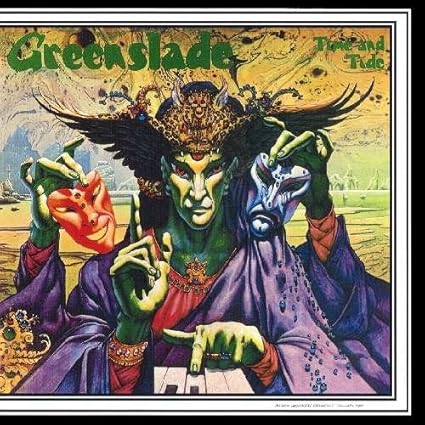
Review – Greenslade: The fag-end of prog and jazz-rock

Time & Tide by Greenslade, 1975


Whenever I want to defend prog rock against the silly consensus that punk was the true revelation of the 70s, this album gives me pause. Amid the sub-Genesis pomposity, including the faux-Edwardian nostalgia, any good musical sections are quickly interrupted by Dave Lawson's horrible yelping vocals, in which every word of his terrible lyrics is cringingly audible. Even at the age of 10, when my brother brought this newly released album home, I thought the lyrics to Animal Farm and Newsworth especially were a bit naff, even though everything my cool elder brother brought home was itself ipso facto cool.

Of course Lawson's vocals are the worst thing about this album, but the whole thing has an air of out-takes and half-baked concepts. Disparate musical ideas are shuffled about with no coherence at all, creating an impression of a band recycling discarded tunes while waiting in vain for some real inspiration to come along. For sure the tracks are shorter and less self-indulgent than on earlier work, but there's nothing to suggest any vision of where the band was to go. And the short answer to that implied question is 'nowhere', since they broke up a few months after the album's release.

I bought the first Stranglers album in 1977 and didn't listen to this again for over 30 years. Revisiting it in 2014, every note is familiar and the tweeness is just as bad as it was then. The jazz-rock fusion of Colosseum is gone and we are left with a band - and indeed a whole musical genre - that had no idea where it was going. Maybe that most over-rated of all bands, The Ramones, were on to something after all.

Tuesday, November 4, 2014

Review: Blue Stockings


Blue Stockings
Blue Stockings by Jessica Swale

My rating: 4 of 5 stars


This play dramatises the failed campaign to award degrees to women at Cambridge University in 1897. It's a splendid piece of drama, and can be forgiven for sacrificing realism for dramatic impact.

Most of the characters, with the exception of Henry Maudsley, are fictitious, but the thrust of the story is true enough. Women had been allowed to study and receive certificates from Cambridge since the 1860s, but were not allowed to graduate. Swale's modern play recounts the failed campaign of 1896-7 to change all that.

In a series of short scenes, Swale charts the progress of four female students and the varying responses of their male counterparts. The responses range from guarded sympathy through derision to outright, violent hostility (and the latter, regrettably, is true enough). There are 25 scenes in the play, which helps create pace while making a few difficulties for staging. The script also calls for four young women and at least four young men, which will cause problems for all but the biggest amateur societies trying to stage the play.

Swale opts for vigorous dialogue at the expense of period realism. This would be forgiveable if it were solely for dramatic effect, but I feel she didn't really think it through. One could forgive the young ladies talking of Van Gogh and Einstein, even if it's implausible that teenage students in 1896 would have heard of either in 1896, but the word 'hassle' wasn't even invented then, and no Cambridge lecturer would have said 'millennia' when she meant 'millennium'. The numerous anachronisms seem more careless than deliberate.

Still, it's a vibrant, vigorous play that brings a historical story to life.


View all my reviews